Friday, June 22, 2018

More Maori

Today the team revisited the HMS Maori once again. As always our goal was to try and get more footage and better footage of the wreck. What made today different were some new approaches to mission planning. First we re-ran prior missions created using Sam and Russel's planning software, but using a new rough bathymetry map which allowed us to plan for the AUV to reach greater depths. This allowed us to get a closer look at the Maori and capture previously unseen angles. Afterwards we tried Mitchell's new prototype planner which attempts to best enable photogrammetry by working out AUV paths by approximating the shape of regions of interest. Additionally we tried mounting one camera right facing in the hopes of capturing better data of the sides of the ship, which have previously been difficult to make out due to poor visibility and the higher depth AUV paths.

Russel and Dr. Wood deploying the IVER
Sam and Russel's plans worked excellently, and the added depth allowed us to see portions of the ship in wonderful detail. Likewise, Mitchell's alternative planner also performed very well, and it resulted in several clips that show the Moari from previously un-captured perspectives. It's too early to tell exactly how this will change the final reconstruction, but the results are very encouraging. Unfortunately it seems that none of today's missions went deep enough for the right facing camera to get good footage, however I think with a little tweaking we can capture some great data, and fill in a lot of blanks on the reconstruction.


June 22

The Fluid Mediterranean

About a month before I traveled to Malta, I received proofs of an article on an Early Modern English play called The Knight of Malta. The timing was quite fortuitous, reminding me not only of my research interests in the construction of racial difference via ideologies of religious difference, but also of my interest in Mediterranean piracy, which like the sea offered fluid opportunities for enterprising individuals to raise their social status and sometimes border-cross between religious communities.

While in Malta, I’ve been able to go to the National Library of Malta to do some research on the privateering or corsairing, as it was commonly referred to from the sixteenth to the nineteenth centuries. Most of the work I had done previously on corsairs was from either the English or the Ottoman perspective, so it was quite eye-opening to get a perspective on this activity from Malta because the island and its inhabitants have long been positioned by English writers as being the bulwark of protection against the Ottoman onslaught in the western Mediterranean. The island and the Order of St. John gained particular fame after successfully repulsing the Ottoman attack of 1565, known throughout Europe as “The Great Siege of Malta.”

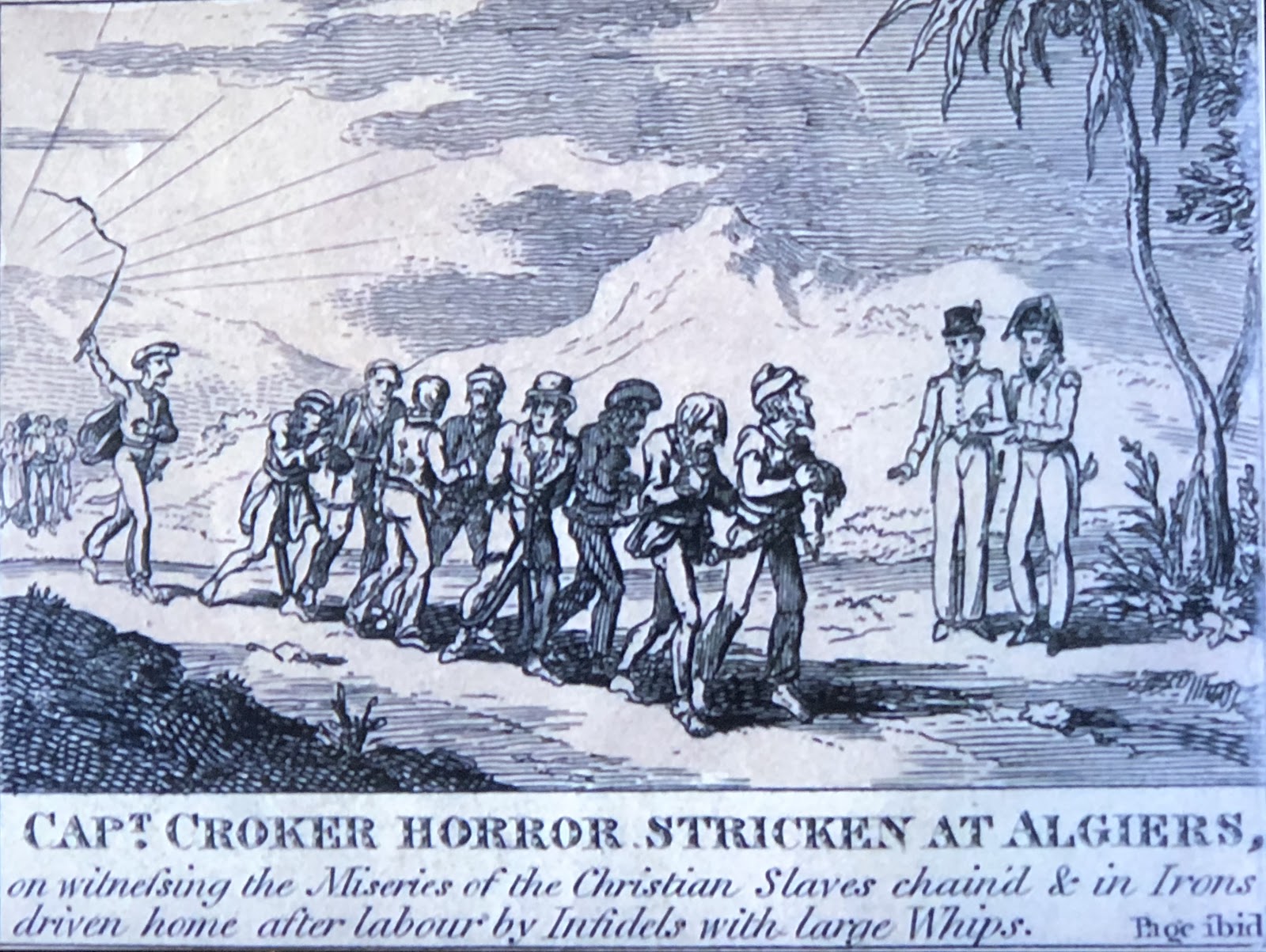
What drew my interest to Maltese corsairs was the reputation they had in some English contexts as being indiscriminate in their attacks on Christian and Muslim ships in the Mediterranean, and that they would engage in enslaving both Muslims and Christians. I emphasize religion here because that’s what often got emphasized in early modern texts, that the conflict in the Mediterranean was rooted in religious antipathy and an extension of the crusades. This framing unfortunately obscures the very many ways in which peoples from different religions, such as Christians, Muslims, and Jews lived, worked, and cooperated with each other in the Mediterranean in the early modern period and beyond. In addition, by focusing on religious conflict as the reason why these activities took place, we also ignore how a career on the high seas could allow men from lower stations in life to rise in rank. Finally, we also deny the region the kind of cosmopolitanism it had vis-a-vis religious toleration and cooperation that it had for many centuries. To be sure there were wars, but most often they were about territory, money, and imperial ambition, with the veneer of religion applied on later for good measure.


During my time in Malta, I’ve remembered what animated my research in this time period and particularly in this geography. The Mediterranean has a long and rich history and it is connected to the history of the world. Columbus sailed west because the route to the Mediterranean were already controlled by the Ottomans and Venetians and because the Portuguese had managed to secure a route around Africa, the Cape of Good Hope. That voyage,introduced Europeans to new land and peoples, and policies that were de rigueur in the Mediterranean, like slavery, took on new forms when they crossed the Atlantic. What I hope will come from my research in Malta this summer is a better understanding of the connections between the Mediterranean and Atlantic worlds in this time period.

Images courtesy of Liam Gauci

Thursday, June 21, 2018

June 21th

Today the ICEX team had a break from all the hard work and got the opportunity to explore Malta on our own. Makoto went out in hopes of finding someone to interview for the cultural project Professor Dadabhoy is helping us with. He went to explore some of the war museum in Valetta and ended up interviewing one of the reenactment employees at the Upper Barrakka Gardens.  Kole went out to explore the shoreline and went snorkeling around the point. He also got the chance to look at some tidepools and view some of Maltas marine life.
Marine life off the coast of Malta


Sam and Nandeeka left early in the morning in search of something active to do such as rock climbing or hiking.

Bonita, Russell, and Mitchell went to tour the streets of Valletta and explore some of the cuisine that Malta has to offer. They were also able to witness the firing of the canon at the Upper Barrakka Gardens.

Later in the evening, everyone returned to the apartment for a very interesting lecture. As a Historian, Liam Gauci has been studying history from the 1800's. He believes that history is best told through human stories. He presented a lecture on the Corsairs from Malta and the culture and history of it all. Overall, it was a very insightful and entertaining lecture on some of Malta's past.

Wednesday, June 20, 2018

June 20th

Today after doing 10 legs of sonar scanning we completed our final day of surveying. MVP goes out to  Makoto and Russell for making it on every boat deployment and helping to get great sonar data for the team.

Getting Ready for Deployement


Anchor Drag Found in the Sonar


Mitchell and Russell Bringing in the IVER


This afternoon we ventured to the grocery store together to get supplies to make a nice homemade dinner.

Pictured (Left to Rigtht):  Makoto, Nandeeka, Sam, Bonita, Mitchell


Tony Burgess came later in the day to give a fantastic talk on underwater aviation archaeology.


Tuesday, June 19, 2018

June 19th Deployments

The ICEX team went out on the boat this morning for some early morning deployments. The team was able to complete 9 more legs of the survey today. The winds were much more forgiving today which allowed for a smooth deployment.


Kole and Bonita carrying the AUV 

Kole getting the AUV safety into the ocean
Bonita, Kole, and Russell watching the AUV surface


Dr. Gambin also met with the ICEX team today in order to discuss potential targets from the last two deployments. The team was better able to identify potential targets thanks to Dr. Gambin.

The ICEX team spent the rest of the day coding and working before going out to dinner and enjoying some gelato afterwards. 


Monday, June 18, 2018

June 18th

This morning members of the ICEX team: Professor Wood, Kole, Makoto, and Russell, started their day with a deployment. They were able to complete 9 legs of survey before coming in due to high winds and increased swells.


John, Kole, and Makoto getting ready to deploy

Professor Wood enjoying her first survey of Summer 2018


While they were deploying Mitchell worked on a program using maps, made by Sam, that show high interest areas from the sonar data. The program creates bounding boxes of those areas and can be used to make an AUV path to gather more film for the 3D reconstruction.


Work in progress of Mitchell's program

Later than afternoon, as a team, we went over the sonar data in hopes of finding a wreck. While looking we came across some interesting looking features, maybe to explore later.
Shortly after a few members of the team took a short break down at the Point.


Professor Wood and Makoto looking over sonar data
Russell enjoying the view at The Point


We ended the day getting dinner together at a traditional Maltese restaurant.


Kole trying to get that Instagram worthy picture of his calamari


Sunday, June 17, 2018

June 17th Deployments

The ICEX team went out to St. Elmos Bay for some early morning deployments. One of the goals for the deployments today was to get good video footage for the photometry reconstruction. Several of these missions yielded good results of the wreck.


Here is video of a fly by of the AUV as it goes over the wreck of the Moari. You can see the top of the Moari as well as a car located on the ocean floor.


Professor Clark was also able to dive down and collect video footage manually of certain parts of the wreck.

He was also able to capture footage of the AUV as it zoomed by him during his dive.


The ICEX team carefully getting the AUV in the water.

Today was also Professor Clark's last day in Malta for the duration of the trip as he will be heading back home tomorrow. We all went out for gelato and said our goodbyes. You will be missed Professor Clark.


ICEX 2018