Sunday, June 10, 2018
First Attempts at RRT Planner Missions!
Today, Russell and Sam began using the missions generated by their RRT planner. Their algorithm was designed to generate missions that would provide maximum information gain of the wreck. More newly-generated missions are planned to be run this afternoon, which are shown in the matplotlib and VectorMap files below.
Saturday, June 9, 2018
Exploring Valletta 6/8
We had planned to do another deployment in St Elmo's Bay on Friday morning, so we all woke up early and went back to the bay. Sam and Russell had built an information map of the Maori wreck using the sonar images from Wednesday, and used it to plan missions to get camera and sonar data for the CalPoly team. Mitchell and Nandeeka also planned some new lawnmower missions to get clean sonar data of the entire wreck. Makoto, in an effort to find bolts to properly attach the camera lights to the robot, stayed behind to wait for a DIY store to open to get the necessary hardware.
Unfortunately, when we reached St Elmo's Bay, the winds were upwards of 35 km/hr, too strong for a deployment. However, looking ahead, we noted that the winds were going to die down by Sunday. So, we switched our schedule around and decided to explore Valletta on Friday and do the deployment on Sunday.
Since we no longer had an ecab to transport all seven of us and the IVER, Prof Clark and the robot went back to drop off the robot while we walked to a cafe and hung out while waiting for him and Makoto.
After getting everyone together, we first went to the St John's Co-Cathedral where we walked around and did an audio tour describing the different rooms. works of art, and history of the place.
We then walked to the Upper Barrakka Gardens, and although we just missed the cannon fire, we got a nice view of the Grand Harbor.
The next stop was another cafe for a late lunch and some desert.
Finally, we explored the palace armory and admired rows of cannons, guns, and full body armor. In the same area, there was a Picasso and MirĂ³ exhibition.
Unfortunately, when we reached St Elmo's Bay, the winds were upwards of 35 km/hr, too strong for a deployment. However, looking ahead, we noted that the winds were going to die down by Sunday. So, we switched our schedule around and decided to explore Valletta on Friday and do the deployment on Sunday.
Since we no longer had an ecab to transport all seven of us and the IVER, Prof Clark and the robot went back to drop off the robot while we walked to a cafe and hung out while waiting for him and Makoto.
![]() |
| Prof Clark and the IVER ready to go back to Sliema |
![]() |
| Iced Coffee and Pastizzi from the Cafe |
![]() |
| Nandeeka, Sam, and Bonita (not pictured) were made to wear shawls and wrap skirts to dress more modestly |
![]() |
| View of the co-cathedral from a balcony above |
![]() |
| Cannons and the Grand Harbor from the Upper Barrakka Gardens |
![]() |
| Sam's Sunday |
![]() |
| Mitchell with a cannon |
![]() |
| Makoto with a painting |
Friday, June 8, 2018
Day 3 in Malta
Day 3 was a slightly uneventful day since weather conditions (mostly high winds which created choppy conditions) prevented us from deploying the IVER. Professor Gambin came in the morning to train everyone on using the Sonar Wiz software. This allows us to create geo-referenced images of the side scan sonar runs and also larger images with many different sonar runs overlaid on one another. This allows us to create much more accurate estimations of the positions of wrecks in data and much more information in general for identifying shipwrecks and planning paths. For example, with the overlay of different sonar scan paths, a scan of a wreck can be made with much less shadow which is much more crisp and has more detail. This could help us in identifying wrecks. For path planning, the sonar can be used to find the height off bottom of various wrecks, which is a useful term in identifying areas of high information gain.
- Makoto
| Maori Wreck Sonar Image |
In the afternoon we also had a lecture from Professor Keith, who discussed water treatment in Malta, and the unique challenges faced by an island with a fairly arid climate and a booming population. Most of the research that he has conducted has focused on wells and cisterns. Wells are able to retrieve water from deep aquifers while cisterns hold rainwater that has collected after storms. Professor Keith's lecture also covered the various types of rocks that are found on the island, their various permeabilities and the effects that they have on the formation of various freshwater sources on the island. Finally, Professor Keith also mentioned the effects that such buildups of fresh water affected the population growth and centers on the island, with Medieval Maltese people congregating around large sources of water. These sources are now at a critically low point, with the Maltese government compensating for them with a variety of water purification processes.
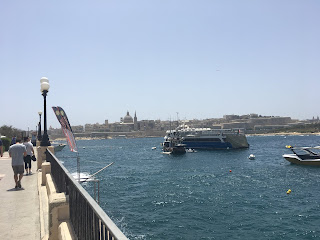
At the end of the day we also walked along the coastline of Sliema and explored a bit, getting some nice pictures and trying to scope out some good restaurants as well as swimming spots. (one was discovered on the southwestern part of Sliema's point). Below are some pictures of Sliema's waterfront along with some pictures of the abundant cranes
| Sliema waterfront, facing East |
| Sliema waterfront, facing Southeast |
| Cranes on Sliema waterfront |
The Siege of Malta
The Siege of Malta
Malta occupies a key position in the Mediterranean, especially since it provides a base for naval and air forces to deploy from essentially controlling naval passage around the Mediterranean. War was already being waged in Northern Africa, mostly over control of the Suez Canal and various colonial interests that Germany, France, Italy and Britain had along the northern coast. Since control of Malta, at that point a British colony, meant control over the shipping lanes around the Mediterranean, it immediately became a target for Axis forces. The Siege of Malta began almost immediately as the Italians declared war on the Allied Forces in 1940. The siege, was waged almost primarily in the sky, contrary to the initial assumptions of the British Forces, who thought that the island would be protected by a decently strong naval presence. However, the Italian Air Force waged a somewhat successful campaign agains Malta, dropping bombs and damaging key targets on the island. The defenses on the island were severely limited when the siege began, consisting mostly of Gladiator biplanes and some anti air guns. These had limited effect against the invading force and the Italian air force conducted their operations relatively unhindered. However, the effect of their raids was limited and was small scale enough that British forces brought in reinforcements in the form of Hurricanes and a few more destroyers to the island relatively unopposed. The Hurricanes represented a huge step up from the outdated Gladiators, and the combination of those with Sea Fairey torpedo bombers and a greater submarine and naval presence were extremely effective for a short while, forcing the Italian forces back to Naples. However, this defeated brought the attention of the Germans on the island, which then deployed part of it's navy and several squadrons of the Luftwaffe to aid the Italians in their campaign. British forces on the island started to suffer heavy casualties against the much more experienced and well equipped Luftwaffe pilots. The Axis gain air superiority and their shipments to the rather beleaguered North African campaign were able to run unhindered during mid 1941. During this time, large amounts of explosives were also dropped on the island, mostly damaging civilian homes. Germany's Balkan campaign combined with Operation Barbarossa and the invasion of Russia led to the Luftwaffe forces being deployed elsewhere, with the Italian Air Force (Regia Aeronautica) left to continue their air campaign. This allowed the Allies to recover, with their forces receiving much needed reinforcement and supplies. These reinforcements allowed them to actually go on the offensive, sinking half of the tonnage that the Axis attempted to send to Northern Africa. This continued until December of 1941 when Germany sent back several squadrons of the Luftwaffe and almost half of it's U-boat float in order to sink Allied ships in the area as well as provide protection for their supply convoys. A more effective bombing campaign was once again put into effect and the Axis regained air supremacy over the Mediterranean and their shipments were able to pass through unhindered. The return of the Luftwaffe and their Messerschmitts meant that the Hurricanes stationed at the island, despite being a vast upgrade from the Sea Gladiators, were seriously outclassed. As a result, since moral was low, the British command at Malta requested the delivery of Spitfires to the island in order to help regain air superiority. An Axis plan to invade the island was scrapped due to faulty intelligence reporting much stronger defenses on the island than existed. The requested Spitfires were eventually delivered and with them, provided the much needed air superiority over the Luftwaffe. Spring 1942 saw the greatest number of Axis forces arranged against the island, but the Spitfires helped reduce their number to a mere fraction of what they were and the RAF once again ruled the skies of the Mediterranean. However, there were deeper problems for the Allied forces on the island. Their supplies had fallen to critically low levels and they were in desperate need of a convey carrying supplies. The Axis forces were aware of this and hounded convoys headed for Malta. Two convoys were forced to turn back and were unable to deliver their shipments, while one convoy made it but after suffering heavy casualties. In response to this, the Allied forces swapped the commander at Malta from Hugh Lloyd to Keith Park, a commander more experienced in air combat, which was the dominant form of offensive and defensive action around Malta. This, combined with the deteriorating position of Germany in Northern Africa and in the European theater meant that the Allied forces were able to gain the upper hand in the battle and begin raiding the Axis supply runs with abandon. Eventually, as Italy found itself in a worse and worse position during the war, air raids on Malta by the Regia Aeronautica ceased completely and the siege on Malta was lifted.
- Makoto
Wednesday, June 6, 2018
First Day in the Water!
![]() |
| Sam + Makoto with a view of Sliema |
![]() |
| Cal Poly team with Fort St. Elmo |
Even though we had some trouble with the maps and getting the robot in the water through surging waves, it was a truly exquisite day to be outside in such a beautiful place -- blue sky, clear water, and cool wind to cut through the heat. It was a successful first deployment, and it taught us the valuable lesson of making sure that the GoPro is turned on before sending the robot out. We're already looking forward to many more days of great times by the sea.
![]() |
| Taking off the fins + kawaii Sam |
-Russell
Tuesday, June 5, 2018
First Day in Malta!
Hello from Malta! Today is our first full day here, and the seven of us are getting settled into our apartment.
Yesterday was a big day of travel; we went from LAX to our layover in Zurich. On the plane, Bonita took some artsy shots of our airplane food.
| Dinner! |
| Breakfast |
Keeping up the trend of food photography, Makoto and I took some very basic photos of our dinner in the Zurich airport before our flight to Malta.
![]() |
| Dinner in Zurich |
We then flew into Malta and arrived at our apartment, which is only two blocks away from the ocean. We went out on a quick walk to check out the area around our apartment.
This morning, we woke up and set off to the supermarket to buy food and other supplies for the week. After a quick lunch, we began rebuilding our robot together.
After a few hours, we have finally finished assembly and are hoping to get in a quick drive by wire run or short mission later this afternoon. We are excited to get out on the water and begin gathering data for our research!
Long Beach Deployment 5/29
Before going to Malta, we wanted to do one deployment in a deeper body of water than pHake Lake. After our boat to Catalina was cancelled, we decided to go to Mother's Beach in Long Beach. We took both the IVER3 to run ICEX missions as well as the IVER2 to do testing for the AUV magnetometer project.
When we reached the beach, our first order of business was re-ballasting both IVERs. Unfortunately, we had only brought enough weight to ballast one IVER at a time. We first ballasted the IVER3 and ran a couple missions. First, we just sent the robot out and back, then we ran lawnmower missions on the surface and with diving. We were also successfully able to run missions planned by the path planning team. Similar missions were run on the IVER2.
After a Subway lunch, we packed everything up and came home.
Subscribe to:
Posts (Atom)
-
The temples of Malta are a source of a rich culture for both the island and the people. I was lucky enough to be able to visit one of the te...
-
A few days ago, we traveled to Gozo for our cultural outing, and during at lunch at the Maltese restaurant, Xerri Il-Bukkett, I was lucky en...
-
The Knights of St John may have only occupied the island from 1530-1798, but they left a clear mark on the Maltese landscape and cultural he...